


In the 35 years of his career as a diplomat Pascal Alan Nazareth had numerous opportunities to witness and watch from close quarters varied people, governments and cultures, societies of all hues, religion, race and ethnicity. This exposure helped him realize that the only way to promote peace and harmony in today’s highly polarized world, is by reviving and promoting Gandhian ideals of truth and non-violence.

Pascal Alan Nazareth
Having realized that Gandhi is much more relevant these days Alan Nazareth founded the Sarvodaya International Trust in 1995, trying his best to promote and propagate Gandhian ideals and the need to follow Gandhi in letter and spirit in a form and manner to suit the contemporary age. Florine Roche, DaijiWorld
Gandhi, Christ and Christianity
Gandhi’s fundamental contribution in the field of religion was to give primacy to Truth and rationality rather than conformity to traditional practices. In fact he made Truth the basis of all morality by declaring: “I reject any religious doctrine that does not appeal to reason and is in conflict with morality”.


 My sister Ela Gandhi, granddaughter of Mahatma Gandhi, was born in 1940 in the Phoenix Settlement in the Inanda district of KwaZulu Natal, South Africa. An anti-apartheid activist from an early age, Ela was banned from political activism in 1973 and placed under house arrest for a total of nine years. After her imposed sanction, Ela became a member of the
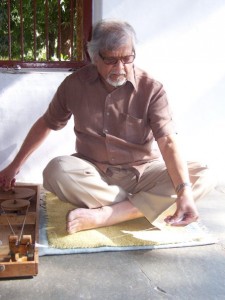


 Ed note: The following is a transcript of an interview by ISKRA staff with Arun Gandhi that took place on March 19, 2013. Arun is the grandson of Mohandas (Mahatma)Gandhi and heads the Gandhi Institute for Nonviolence located in Rochester, NY. He has previously made appearances in Brilliant as well as Grand Forks and will be speaking at the Brilliant Cultural Centre on May 17, 2013. We feel fortunate to have the opportunity to interview Arun and ask him several questions provided by our ISKRA staff as well as members of the broader Doukhobor community. It was truly a pleasure to converse with this soft spoken advocate of peace and nonviolence. We were impressed with the simplicity and wisdom contained in the philosophical views that he shared with us. We encourage our readers to reflect on his comments.

 Of course my main inspirations have always been my grandparents and parents but they also taught me to always keep an open mind so that I can absorb the nuggets of wisdom that come from the most unexpected sources. They also taught me that life is a learning experience and that learning does not stop when we leave school. If we wish to learn from life it is important to be awake, aware and accepting of lessons that come from all sources. I get inspiration from small children, from the homeless, from people in the streets, from trees, from places I simply can’t pinpoint. Learning in this life is somewhat like digging for diamonds. We must go on digging a lot of dirt and in the midst of that we sometimes find what we want. The more we dig the more we realize that what we want isn’t all there is and may not be what we need.
  be compared to 67 years ago when he was living in India with his grandfather Mahatma Gandhi. The second ring reinforced the similarities: the wars, the conflicts and the ongoing need for peace. He answered on the third; his voice a bridge.
 It is our voracious appetite for oil and natural gas at a cheaper price that spurs the industry to exploit the earth’s natural resources, so, not surprisingly, the consumer is a guilty as the producer. None of us raised a voice when the same industry was exploiting and devastating the environment and resources of other countries to feed the monster in our backyard. Now that the world has become wise and curtailed the power of the Oil Industry to plunder the resources in their countries we do not want them to do the same in our backyard with natural gas. Clearly, the choice before us is: Do we stop the monster that is set on ruining the earth for future generations or do we mindlessly sacrifice the future generations.

 For generations human beings around the world worked hard to attain peace but their efforts ended mostly in heart-breaking futility leading to pessimism and worse. There is a wide-spread belief now that peace is unattainable and that civilization is doomed to perish by violence. When peace appears to be won through violence it is very temporary because violence subjugates the opponent. When we seek to control someone through fear of punishment or violence or superior force that control remains only as long as the dominant force is able to exert fear. Since human beings realized in pre-historic times that they could survive in jungles only by using force they developed a whole “culture of violence” that gradually came to dominate every aspect of human life. Our language, our behavior, our relationships, our attitudes, in short almost everything about the human being is now conditioned by the “culture of violence.” Generations have now come to believe that violence is human nature and one just has to live with it. I hope by the time you finish reading this chapter you will be convinced that violence is not human nature.


 Aurora Batman Violence: My heart goes out today to the people of Aurora who have suffered this immense and mindless tragedy. To those who have lost their loved ones and to those who escaped with injuries this incident will never make any sense.

 Sixty years after his death a portion of Gandhiji’s ashes, stashed away by Madalsa and Shriman Narayan, the daughter and son-in-law of Jamnalal Bajaj, will be immersed at Chowpati Beach in Mumbai. Although I will be thousands of miles away in the United States the memories of sixty years ago will be refreshed and the day will be as poignant as January 30, 1948. In 1969 when the world celebrated Gandhiji’s 100th birth anniversary many of us who had lived in Sewagram Ashram, Wardha, with Gandhiji were invited for a reunion.
 Arun Gandhi, grandson of the late Indian spiritual and political leader Mahatma Gandhi, is among the most respected and influential figures in the international peace movement. He was born in South Africa where he was subject to the daily injustices of apartheid and yet raised in a family that taught him that justice does not mean revenge but rather transforming the other through love. Arun is the founder of M.K. Gandhi Institute for Nonviolence and the author of five books including World Without Violence and Testament to Truth.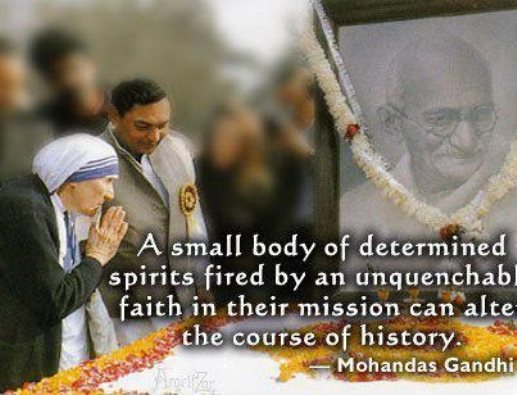

 Leadership in modern times is defined in many different ways but the common factor in each of the definitions is that a good leader must be aggressive, demanding, uncompromising and challenging. There is seldom any talk of a leader having morals and values and humility. The true story I am about to share is different and gives a very unique spin on what a good leader should be like.
 No one would dare go to a battlefield without proper training, equipment and plan of action. Yet, when it comes to nonviolent action it is widely presumed that anyone can simply walk into a struggle without any training, equipment or plan of action. It is also